
Gardening on oceanic islands:

The non-native Great Kiskadee Pitangus sulphuratus as a potential seed disperser of the alien invasive Murraya paniculata in Bermuda
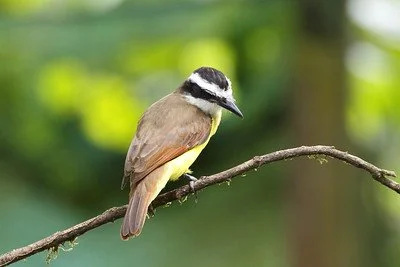
How the Great Kiskadee Is Quietly Changing Bermuda’s Landscape
A recent short communication published in Avocetta takes a close look at an unexpected relationship unfolding across Bermuda’s gardens and wild spaces: the interaction between the non‑native Great Kiskadee and the invasive Orange Jessamine (Murraya paniculata). Although introduced to Bermuda in the 1950s as a form of biological control, the Great Kiskadee has since become an influential—often problematic—species in the island’s ecology. This new study investigates whether the bird may also be helping to spread the seeds of one of Bermuda’s most persistent invasive ornamentals, Murraya paniculata.
Researchers collected and analysed regurgitated Kiskadee pellets during 2022 and 2023 and found that an astonishing 96% of the samples contained Orange Jessamine seeds, strongly suggesting the bird acts as an effective disperser of this invasive plant. As an attractive, berry‑producing shrub widely planted in gardens, Orange Jessamine has already naturalized in many areas. When paired with a bird that feeds on its fruit and spreads its seeds across the island, its invasive potential increases dramatically. [avocetta.org]
This study sheds new light on a growing concern echoed by local environmental agencies: Kiskadees do not just outcompete native birds—they also play a significant role in spreading invasive plants. Other sources confirm that Kiskadees regularly consume berries and seeds and are known to help disperse invasive flora across Bermuda. [thebermudian.com], [environment.bm]
By spotlighting this bird‑plant interaction, the Avocetta article highlights an important truth about island ecosystems: one introduction often leads to many unintended consequences. As gardeners, homeowners, and conservationists consider which plants to cultivate—and how to manage non‑native wildlife—this research is a useful reminder of the complex, interconnected nature of Bermuda’s landscape.
Introduction
On vulnerable oceanic island ecosystems, non-native species may form novel mutualistic interactions with one another and foster establishment. On Bermuda, the omnivorous Great Kiskadee Pitangus sulphuratus was introduced to control the invasive Anolis lizard population, but feeds on many other species of plants and animals. Here we investigated whether the Kiskadee may act as an effective seed disperser of the introduced alien plant, the Orange Jessamine Murraya paniculata. In 2022 and 2023 we collected pellets regurgitated by Kiskadees, and found that 96% (N=26) contained Jessamine seeds. In 2023 we carried out an experiment to compare the germination rates of whole Jessamine fruits with manually de-fleshed seeds and those extracted from Kiskadee regurgitates. Across groups, Jessamine seeds germinated 52.6% of the time. We found only a non-significant tendency for de-fleshed seeds to germinate more often than seeds with flesh (67% vs 49%). Our study highlights that Kiskadee can act as an effective seed disperser of Jessamine in an oceanic island ecosystem.
